
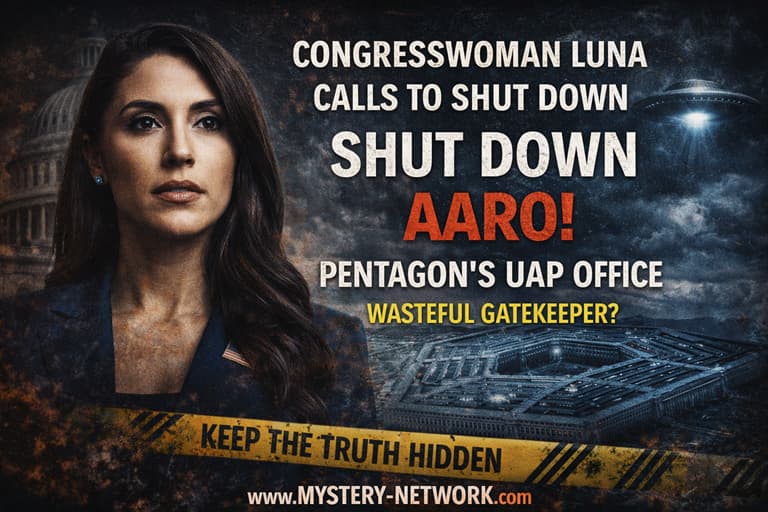
The End of AARO? Congress Moves Against the Pentagon’s UAP Gatekeeper
A growing movement in Congress aims to shut down AARO, accusing it of hiding the truth about UAPs and blocking real disclosure.

The End of AARO? Congress Moves Against the Pentagon’s UAP Gatekeeper
For years, the public was told that the truth about unidentified aerial phenomena was finally being taken seriously. A new office was created. Reports were promised. Transparency became the official narrative.
But now, that narrative is beginning to crack.
U.S. Congresswoman Anna Paulina Luna has stepped forward with a move that could change everything. Her call to dismantle the Pentagon’s All-domain Anomaly Resolution Office — AARO — is not just political noise. It’s a signal that something deeper may be wrong.
And this time, it’s not coming from outsiders.
It’s coming from inside the system.
A System That Was Supposed to Reveal the Truth
When AARO was established, it was presented as a breakthrough. A centralized office that would investigate UAP sightings, analyze data, and provide clarity on what had long been hidden in classified channels.
For the first time, it seemed like the government was ready to be transparent.
But transparency is a word that can mean many things.
Because showing something… is not the same as revealing everything.
The Accusation: A Gatekeeper, Not an Investigator
Critics now claim that AARO has not fulfilled its purpose. Instead of uncovering the truth, it may have been controlling it.
The accusations are serious.
Whistleblowers have described a system where testimonies are ignored, reports are dismissed, and leads are quietly buried. According to these claims, the office does not function as an investigative body, but as a filter.
A gatekeeper.
Something that stands between information and the public, deciding what is allowed to pass through.
And what is not.
The Return of an Old Pattern
For many observers, this situation feels familiar.
Decades ago, Project Blue Book was introduced as a way to study UFO sightings. Officially, it investigated thousands of cases and concluded that there was no evidence of extraterrestrial technology.
Unofficially, it became a symbol of controlled narrative.
A system designed not to discover, but to explain away.
Now, critics are drawing direct comparisons between AARO and that earlier program.
Different name.
Same function.
The Whistleblower Problem
One of the most troubling elements of the current situation is how whistleblowers are treated.
Individuals who claim to have knowledge of classified programs or recovered technologies have come forward in recent years. Some have testified under oath. Others have spoken publicly, risking careers and reputations.
But instead of being fully investigated, many of these testimonies are reportedly dismissed.
Ignored.
Discredited.
This creates a dangerous dynamic. Because if the system designed to investigate claims refuses to engage with them, then what is its real purpose?
The Credibility Crisis
The controversy surrounding former AARO leadership has only intensified these concerns.
Allegations that key figures misrepresented information, attacked witnesses, or failed to properly investigate claims have fueled a growing sense of distrust.
Even within government circles, confidence appears to be eroding.
When insiders begin to question the integrity of an official institution, it signals something more than disagreement.
It signals a breakdown.
A Report That Raised More Questions Than Answers
One of AARO’s major reports was expected to bring clarity.
Instead, it did the opposite.
Critics described it as incomplete, inconsistent, and filled with errors. Rather than resolving the mystery, it deepened it. Instead of answering questions, it raised new ones.
And perhaps most importantly, it reinforced the idea that the public is still not being told everything.
Because when a report meant to explain something creates more confusion than clarity, it stops being informative.
It becomes suspicious.
Congress Hits a Wall
Lawmakers themselves have reportedly faced obstacles when trying to access information.
Briefings have been limited. Requests have been delayed. In some cases, records have been difficult to obtain or simply unavailable.
For elected officials tasked with oversight, this creates an unusual situation.
They are responsible for accountability.
But they are being denied access to the very information they are supposed to oversee.
That is not just inefficiency.
That is obstruction.
The Question of Non-Human Intelligence
At the center of all of this lies the most controversial question of all.
Is there evidence of non-human intelligence?
AARO has consistently stated that it has found no proof of extraterrestrial technology or hidden programs involving non-human entities.
On paper, that should settle the issue.
But for many, it does the opposite.
Because the denial comes from a system that is now being accused of controlling information.
Which leads to a simple but unsettling possibility.
What if the conclusion was decided before the investigation even began?
A Shift Inside the System
What makes this moment different from previous waves of speculation is where the pressure is coming from.
This is not just public curiosity.
This is internal resistance.
Members of Congress are no longer simply asking questions. They are taking action. The call to dismantle AARO represents a shift from investigation to confrontation.
And once that line is crossed, things rarely return to normal.
What Happens If AARO Disappears?
If AARO were to be shut down, it would leave a gap.
But that gap could be filled in different ways.
It could be replaced by a more transparent system.
It could lead to independent investigations.
Or it could simply be reorganized under a different name.
Because structures can change.
But systems tend to survive.
The End of Gatekeeping… or Just Another Layer?
The idea that decades of secrecy could end with a single decision is unlikely.
But the pressure building now is real.
And pressure changes things.
Whether this leads to genuine disclosure or simply a new version of the same system remains to be seen.
But one thing is clear.
The era of silent acceptance is over.
The Real Question
This is no longer just about UAPs.
It is about control.
Control over information.
Control over narratives.
Control over what is considered real.
Because if the truth exists somewhere behind layers of classification, then the most powerful position is not knowing it.
It is deciding who else gets to know.
This may interest you
https://mystery-network.com/blog/wright-patterson-general-disappearance-uap
https://mystery-network.com/blog/steven-spielberg-aliens-already-on-earth
https://mystery-network.com/blog/eric-burlison-uap-weaponized-trump-disclosure